
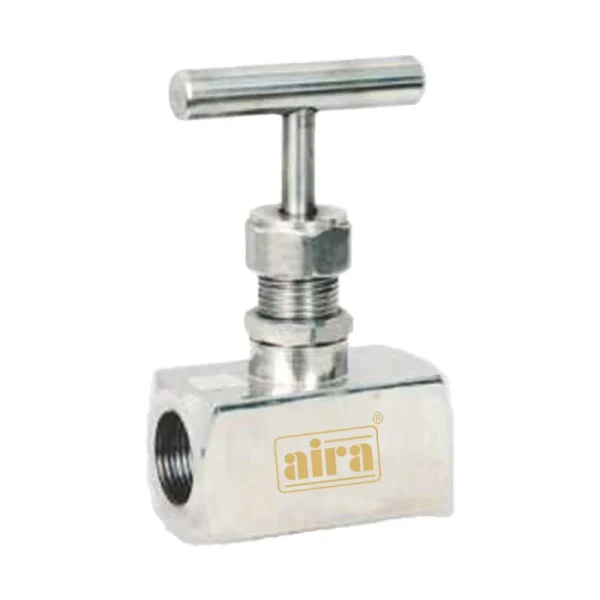
Needle Valves
High Pressure Needle Valve
By Aira Valve Automation
Forged stainless steel needle valve for fine, repeatable flow control and bubble-tight isolation in high-pressure systems up to 700 kg/cm² (10,000 PSI).
Specifications
- Size range
- 1/4" – 2" screwed
- Temperature
- 360°C
- Working pressure
- 700 kg/cm² (10,000 PSI)
- Body
- Forged SS304 / SS316
- Bonnet
- SS304 / SS316
- Leakage
- Bubble tight
- End connection
- Screwed BSP (NPT on request)
Overview
A precision-engineered forged stainless steel needle valve designed for accurate flow control in high-pressure environments up to 700 Kg/cm² (10,000 PSI). The finely threaded needle enables fine, repeatable flow adjustment while maintaining bubble-tight, leak-proof sealing. Built for hydraulic systems, gas distribution, and high-pressure testing setups across oil and gas, chemical processing, and demanding industrial applications. Supplied, sized and serviced for process plants across Nepal.
Features & Benefits
- The finely threaded needle stem gives a large number of stem turns per unit of flow change, which is what enables precise, repeatable throttling at very low flow rates — the defining advantage of a needle valve over a globe or ball valve.
- Forged stainless steel body provides higher grain density and mechanical strength than a cast body, which is essential for safely containing 10,000 PSI without risk of porosity-related failure.
- Bubble-tight shutoff at extreme pressure means the valve can be used as a positive isolation point in instrument and hydraulic lines, not just for throttling.
- Compact screwed-end design installs in tight instrument manifolds and high-pressure test rigs where there is no room for flanged connections.
- BSP standard with optional NPT means the same valve serves both metric and North American threaded systems, simplifying export and multi-market deployment.
- 304/316 stainless construction resists corrosion in oil and gas and chemical processing media, where carbon steel would fail prematurely under combined high pressure and corrosive exposure.